Not Guilty DWI 2nd Verdict in 17 Minutes
Case details
- Trial team: Ian Mayfield
Caitlin Meriwether
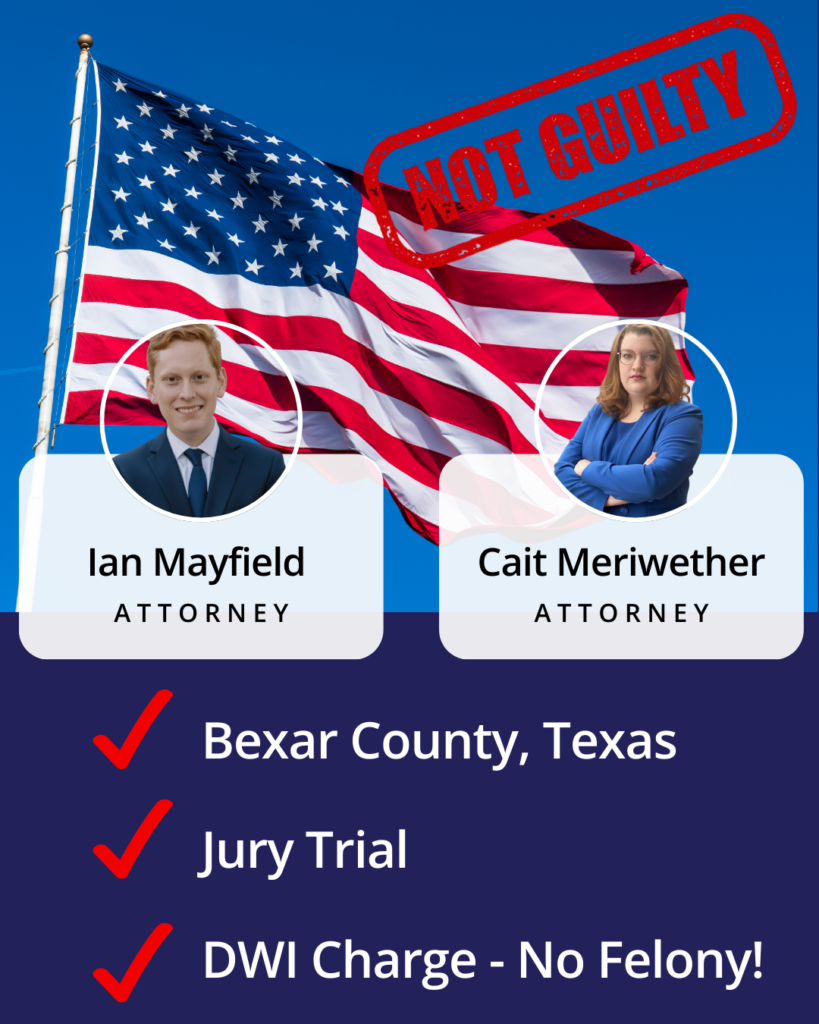
Case Outcome: Not Guilty DWI 2nd Jury Trial Verdict in San Antonio
Dunham & Jones San Antonbio criminal defense attorneys Ian Mayfield and Cait Meriwether secured a Not Guilty verdict in a San Antonio DWI 2nd jury trial. The jury deliberated for 17 minutes before returning its verdict.
This case is a clear reminder of a principle that often gets lost once someone is arrested. The State does not win by accusation. The State wins only if it proves every element of the charge beyond a reasonable doubt. When prosecutors walk into trial with a thin file, weak evidence, and speculation instead of proof, jurors can see the difference.
A DWI 2nd allegation can carry serious consequences. Jail exposure increases, probation terms become more demanding, and the long term cost to a person’s career and family can be severe. That pressure is exactly why DWI 2nd cases often come with plea offers designed to push people into giving up early, even when the evidence is not strong enough to convict.
In this case, the defense refused to let the charge itself substitute for evidence.
The Legal Challenge: A DWI 2nd Charge Without Breath or Blood Evidence
The prosecution started with a standard DWI 2nd probation offer. That offer lasted until the State’s weaknesses became obvious.
The core problem for the State was simple. They did not have the evidence most jurors expect in a modern DWI trial.
Key issues included:
- No breath test evidence
- No blood test evidence
- No expert witness to support scientific claims
- Only one witness presented at trial, the arresting officer
Even with those gaps, prosecutors attempted to build a conviction using hypotheticals. The State suggested what “could have” happened rather than proving what did happen. They raised imagined dangers such as the possibility of an accident or a child being present.
A courtroom is not a place for guesswork. Criminal convictions are not based on theories. They are based on evidence.
Trial Strategy: Keep the Focus on Burden of Proof and What the State Cannot Prove
Ian Mayfield and Cait Meriwether approached the case with a disciplined strategy. The goal was not to argue every detail. The goal was to force the jury to evaluate the case under the correct legal standard.
That meant keeping the focus on:
- What evidence was actually admitted
- What proof was missing
- What assumptions the State was asking jurors to make
- Whether the testimony matched the objective facts
The officer was the State’s only witness. Without lab results, the prosecution leaned heavily on the officer’s interpretation of the stop and the field sobriety tests.
The defense treated that testimony the way a jury is supposed to treat all testimony. They tested it. They measured it against what was shown. They compared it to what was missing.
The State also played a low quality version of its own video evidence. Instead of strengthening the case, it created more uncertainty. When the government relies on unclear footage and fills the gaps with imagination, it invites reasonable doubt.
The Turning Point: Hypotheticals Are Not Evidence
A common move in weak DWI trials is to create fear in the jury box.
- The State may argue that a driver “could have” caused a crash.
- They may argue that a driver “could have” injured someone.
- They may argue that a driver “could have” had a child in the car.
But Texas juries are instructed to decide guilt based on evidence, not fear. This trial made that distinction unavoidable.
Ian Mayfield kept the message direct. The State’s burden is proof beyond a reasonable doubt. Not suspicion. Not a guess. Not a list of scary possibilities.
The jury understood the assignment.
Jury Verdict: Not Guilty After 17 Minutes
After closing arguments, the jury deliberated for 17 minutes and returned a Not Guilty verdict.
That speed matters. It signals clarity. It shows the jury did not need hours to debate whether the State met its burden. The evidence was not there.
This result was not luck. It was the product of preparation, case discipline, and a defense strategy that treated trial like the moment where outcomes are decided.
What This Not Guilty Verdict Means for People Facing DWI Charges in Bexar County
This case highlights several truths that apply to DWI defense across Texas:
- An arrest is not a conviction
- A DWI 2nd charge still requires proof beyond a reasonable doubt
- Prosecutors must show evidence, not possibilities
- Trial is where weak cases get exposed
If you are facing a DWI charge in Bexar County, you should assume the State will pressure you early. Plea offers can look like a “safe” exit, especially when the charge is enhanced. But when the evidence is weak, the right defense strategy can change the outcome.
Why Clients Choose Dunham & Jones for DWI Defense
Dunham & Jones is a statewide Texas criminal defense firm built for the courtroom. We prepare cases for trial because that is what forces accountability. When the State is not ready to prove its case, a trial ready defense is the difference between a conviction and a clean verdict.
This Bexar County Not Guilty result reflects what our trial teams do every day:
- Challenge weak evidence
- Hold the State to its burden
- Cross examine with purpose
- Keep the jury focused on proof
If you are charged with DWI in Texas, the decision you make early can shape the rest of your life. The right defense starts with a real evaluation of the evidence, not a rushed plea based on fear.