Legally reviewed by Chris Jeansonne, Criminal Defense Attorney, Dunham & Jones, Attorneys at Law, P.C. · Last reviewed: August 24, 2026
Most people think of identity theft as someone stealing a credit card number or opening a loan in another person’s name. While those are common examples, Texas law defines the crime much more broadly. In fact, a person can face felony charges even if they never successfully obtain money or complete a fraudulent transaction.
Under Texas Penal Code Section 32.51, the offense is officially called Fraudulent Use or Possession of Identifying Information. Although attorneys, law enforcement, and the public often refer to the crime simply as “identity theft,” the statute reaches far beyond traditional financial fraud.
The law criminalizes intentionally obtaining, possessing, transferring, or using identifying information with the intent to harm or defraud. It also covers identifying information belonging to deceased individuals and children under certain circumstances. As identity theft increasingly shifts from stolen wallets to stolen digital information, understanding how this law works has become more important than ever.
What Is Fraudulent Use or Possession of Identifying Information in Texas?
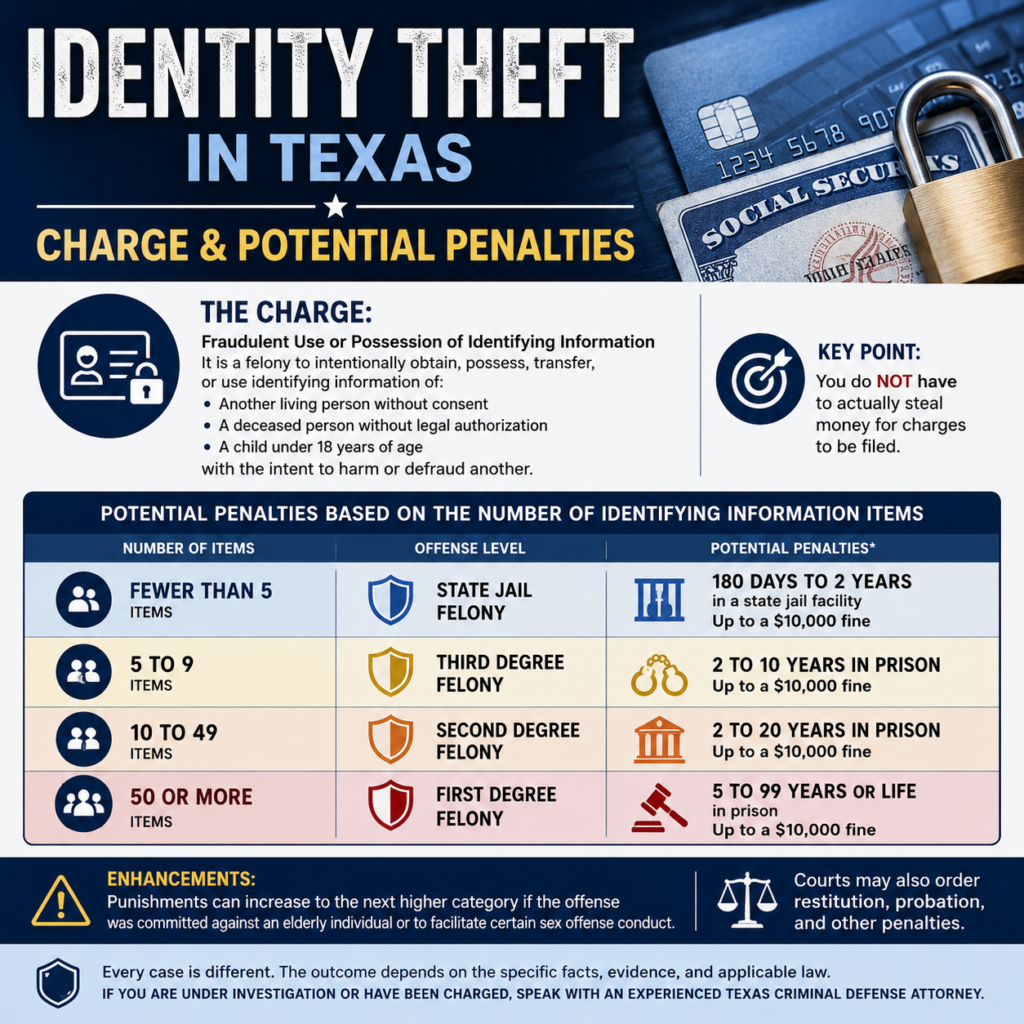
A person commits the offense of Fraudulent Use or Possession of Identifying Information if they intentionally obtain, possess, transfer, or use identifying information:
- belonging to another living person without that person’s consent;
- belonging to a deceased person without legal authorization; or
- belonging to a child younger than 18 years of age;
while acting with the intent to harm or defraud another person.
One of the most important aspects of the statute is that prosecutors do not necessarily have to prove someone successfully stole money or completed a fraudulent transaction. The offense often focuses on the unauthorized possession or use of identifying information together with evidence of criminal intent.
For example, investigators may discover hundreds of stolen Social Security numbers before any fraudulent loans are approved or credit cards are opened. Depending on the facts, criminal charges may still be filed.
Is Fraudulent Use of Identifying Information the Same as Identity Theft?
For most practical purposes, yes.
“Identity theft” is the phrase most Texans use when searching online, but the criminal offense charged in Texas courts is generally Fraudulent Use or Possession of Identifying Information under Texas Penal Code Section 32.51.
The distinction matters because the statute is broader than many people realize. It covers much more than stealing someone’s credit card or opening a fraudulent bank account.
Penalties for Identity Theft in Texas
Fraudulent Use or Possession of Identifying Information is always charged as a felony under Texas Penal Code Section 32.51. The offense level generally depends on the number of legally countable pieces of identifying information involved.
| Number of Identifying Information Items | Offense | Possible Punishment |
|---|---|---|
| Fewer than 5 | State Jail Felony | 180 days to 2 years in a state jail facility and up to a $10,000 fine |
| 5 to 9 | Third Degree Felony | 2 to 10 years in prison and up to a $10,000 fine |
| 10 to 49 | Second Degree Felony | 2 to 20 years in prison and up to a $10,000 fine |
| 50 or More | First Degree Felony | 5 to 99 years or life in prison and up to a $10,000 fine |
Depending on the circumstances, a conviction may also result in restitution to victims, community supervision (probation), if legally available, or additional felony charges arising from the same conduct.
Texas law also contains enhancement provisions that may increase the punishment in certain situations, including some offenses committed against elderly victims.
What Counts as Identifying Information?
Texas law defines identifying information broadly. Examples include social security numbers, driver license numbers, state identification numbers, government-issued identification numbers, financial institution account numbers, routing codes, unique electronic identification numbers, telecommunications identifying information or access devices, biometric identifiers such as fingerprints, voiceprints, retina scans or iris scans, or other information that identifies a specific individual, either alone or in combination with other information.
As technology has evolved, prosecutors increasingly investigate cases involving digital credentials and electronic financial information rather than only physical documents.
Does Someone Have to Lose Money?
No.
Financial loss is common in identity theft cases, but it is not required for prosecutors to bring charges.
The focus of the statute is unauthorized possession or use together with the required intent to harm or defraud. Whether money was ultimately stolen often affects restitution and sentencing rather than whether the offense occurred in the first place.
Can You Be Charged Just for Possessing Someone Else’s Information?
Possibly.
The statute criminalizes possessing identifying information with the required criminal intent. However, simply possessing another person’s personal information is not automatically illegal.
Many professionals routinely possess sensitive identifying information as part of their jobs, including banks, hospitals, attorneys, insurance companies, schools, government agencies, payroll companies and human resource departments.
The difference is authorization.
A hospital maintaining patient records or an employer storing employee tax documents is acting lawfully. Someone possessing another person’s identifying information for the purpose of committing fraud is not.
Texas law also creates a rebuttable presumption of intent to harm or defraud when a person possesses identifying information belonging to three or more other people without their consent. That presumption generally does not apply to legitimate businesses, government agencies, or other authorized entities handling personal information in the ordinary course of business.
What Does “Intent to Harm or Defraud” Mean?
Intent is one of the most important issues in identity theft prosecutions.
Examples that may demonstrate fraudulent intent include opening credit card accounts, applying for loans, filing fraudulent tax returns, receiving government benefits, renting apartments, purchasing vehicles, obtaining employment, making fraudulent insurance claims or selling stolen identifying information.
Simply possessing personal information is not enough by itself. Prosecutors must prove the required criminal intent beyond a reasonable doubt.
Can Parents Be Charged for Using Their Child’s Identity?
Yes.
One of the most emotionally difficult forms of identity theft occurs when a parent or guardian uses a child’s Social Security number or other identifying information for personal financial purposes.
Examples may include opening credit cards, applying for personal loans, financing vehicles, opening utility accounts, leasing an apartment and obtaining financing using the child’s credit history.
Some parents mistakenly believe they have unlimited authority to use a child’s identifying information because they are the child’s legal guardian. While parents routinely use a child’s identifying information for legitimate purposes such as health insurance, taxes, or school enrollment, they do not automatically have authority to use that information to obtain personal financial benefits through fraud.
Children often do not discover the damage until years later when they apply for student loans, apartments, mortgages, or their first credit card.
The fact that the victim is the defendant’s child does not automatically prevent criminal prosecution if the statutory elements of the offense are satisfied.
Can a Fake ID Result in Identity Theft Charges?
Sometimes.
Many teenagers assume using a fake driver’s license only creates problems if they are caught purchasing alcohol or tobacco products. In reality, the applicable criminal charges depend on how the fake identification was created and whose information appears on it.
For example:
- Using another real person’s identifying information may support identity theft charges.
- Altering a genuine government-issued identification document may lead to forgery or tampering charges.
- Manufacturing or selling fake identification documents may expose someone to additional felony offenses.
On the other hand, a teenager who simply presents a fictitious identification to purchase alcohol is often charged under more specific alcohol or identification laws rather than Texas’s identity theft statute.
Whether identity theft charges apply depends on the specific facts, including whether another person’s identifying information was used and whether prosecutors can prove the required intent to harm or defraud.
Identity Theft Can Happen Within Families
Many people believe identity theft only occurs between strangers.
In reality, criminal investigations frequently involve spouses, former spouses, adult children, parents, siblings, caregivers and elderly family members. The family relationship alone does not prevent criminal charges.
If prosecutors believe someone intentionally used another family member’s identifying information with the required criminal intent, identity theft charges may still be filed.
Is Using a Deceased Person’s Identity Illegal?
Yes.
Texas law specifically addresses identifying information belonging to deceased individuals.
Examples may include filing fraudulent tax returns, collecting government benefits, opening financial accounts, applying for loans and accessing retirement or insurance benefits. These investigations may also involve federal agencies depending on the circumstances.
Online Identity Theft Is Becoming More Common
Modern identity theft investigations increasingly involve electronic information rather than stolen wallets.
Examples include online banking credentials, payment applications, cryptocurrency accounts, email accounts, e-commerce accounts, cloud storage services and digital financial accounts.
Not every hacked online account constitutes identity theft under Texas law. However, digital investigations often uncover identifying information that may support identity theft or related fraud charges.
How Texas Counts Identifying Information
One of the most misunderstood aspects of Texas identity theft law is how felony levels are determined.
Many people assume prosecutors simply count the number of victims. That is not necessarily how the statute works.
Instead, the offense level depends on the number of legally countable pieces of identifying information involved. Determining what qualifies as a separate item can become a complicated legal issue and has been the subject of appellate court decisions.
For example, a single investigation may involve multiple pieces of identifying information belonging to one victim or identifying information belonging to numerous victims. Exactly how those items are counted can significantly affect whether an offense is prosecuted as a state jail felony or a first-degree felony.
Because the law is highly technical, disputes over how identifying information should be counted frequently arise in serious identity theft prosecutions.
Related Criminal Charges
Identity theft investigations often involve additional criminal offenses, including Credit Card Abuse, Forgery, Theft, Tampering with Government Records, Computer Crimes, Unauthorized Access of a Computer, Mail Theft, Wire Fraud and Money Laundering.
Depending on the facts, state and federal prosecutors may pursue multiple charges arising from the same course of conduct.
Defenses to Identity Theft Charges
Every case depends on its unique facts, but possible defenses may include lack of intent to harm or defraud, consent or lawful authorization, mistaken identity, insufficient evidence, lack of knowledge that the identifying information was stolen, illegal search or seizure or misidentification.
Because identity theft cases often involve digital evidence, financial records, forensic analysis, and complex statutory interpretations, experienced legal representation can be critical.
What Should You Do If You Are Accused?
If you are investigated or arrested for Fraudulent Use or Possession of Identifying Information, avoid discussing the allegations with law enforcement before speaking with an attorney.
You should also avoid contacting alleged victims or deleting electronic records, phones, computers, or financial documents, as doing so could create additional legal issues.
An experienced Texas criminal defense attorney can evaluate the evidence, explain the charges, and help protect your rights throughout the criminal process.