Legally reviewed by Chris Jeansonne, Criminal Defense Attorney, Dunham & Jones, Attorneys at Law, P.C. · Last reviewed: September 1, 2026
Resisting arrest and running from police may sound like different versions of the same conduct, but Texas law treats them as separate criminal offenses. A person can also face charges when the situation looks very different from a physical fight with an officer or a high-speed police chase.
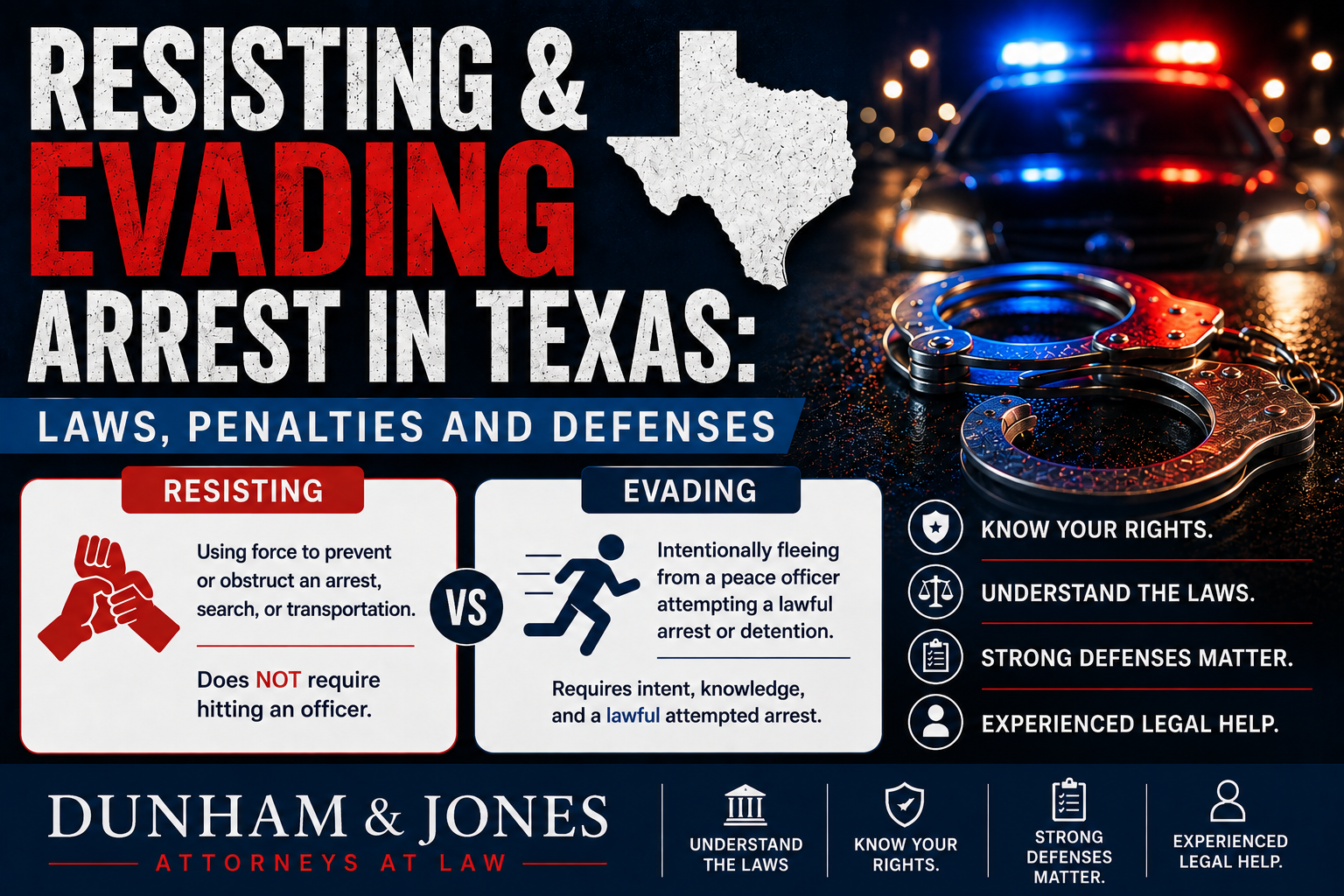
Texas Penal Code Section 38.03 covers resisting arrest, search, or transportation. Section 38.04 covers evading arrest or detention. The required conduct, possible defenses, and penalties differ significantly between the two offenses.
What Is Resisting Arrest in Texas?
A person commits resisting arrest, search, or transportation when the person intentionally prevents or obstructs a known peace officer, or someone acting in the officer’s presence and at the officer’s direction, from arresting, searching, or transporting the person or another individual by using force against the officer or another person.
This means resisting is not limited to fighting while being handcuffed. The statute can also apply to physically resisting a search or transportation after an arrest.
Do You Have to Hit a Police Officer to Resist Arrest?
No. Resisting arrest does not require punching, kicking, or intentionally injuring an officer.
Texas courts have held that force used in opposition to an officer’s physical efforts can satisfy the statute. Forcefully pulling an arm away from an officer attempting to handcuff someone, for example, may qualify as force against the officer.
Actually striking, pushing, or injuring an officer can create additional legal problems, but a person can potentially commit resisting arrest without ever attacking the officer in the ordinary sense of the word.
Is Passive Noncompliance Resisting Arrest?
Not necessarily. Texas law requires more than simply being uncooperative.
Arguing with an officer, verbally protesting an arrest, refusing to answer questions, or failing to cooperate does not automatically constitute resisting arrest under Section 38.03.
Even physical noncompliance can present a more complicated question. Someone who simply goes limp or lies motionless is in a different position from someone who pulls against an officer’s grip, twists away, braces against an object, or deliberately drops their body weight in opposition to officers attempting to move them.
Texas courts have considered conduct such as deliberately dropping one’s body weight, pulling away, and physically opposing an officer’s efforts when determining whether a defendant used the force required for resisting arrest.
The distinction is therefore not simply between touching and not touching an officer. The issue may be whether the defendant intentionally exerted force against or in opposition to the officer’s physical efforts.
Can You Resist an Unlawful Arrest in Texas?
Generally, the fact that an arrest or search was unlawful is not itself a defense to resisting arrest.
Texas Penal Code Section 38.03 expressly says that unlawfulness of the arrest or search is not a defense to prosecution.
This creates a counterintuitive possibility. The original criminal allegation might later be dismissed, or an arrest or search might be found unlawful, while a separate resisting charge survives.
Texas law does recognize limited circumstances involving excessive force by police. Section 9.31 addresses when responsive force may potentially be justified if an officer uses or attempts to use greater force than necessary before the person offers resistance. These situations are highly fact-specific.
What Is Evading Arrest or Detention in Texas?
A person commits evading arrest or detention when the person intentionally flees from someone they know is a peace officer or federal special investigator who is attempting lawfully to arrest or detain them.
Unlike resisting, evading does not require force against another person.
It does require intentional flight, knowledge that the person is a qualifying law enforcement officer, and a lawful attempted arrest or detention.
This last requirement creates an important distinction between the two offenses. The unlawfulness of an arrest or search is expressly not a defense to resisting under Section 38.03. For evading under Section 38.04, however, the State must prove that the attempted arrest or detention was lawful.
What If You Did Not Know Police Were Trying to Stop You?
Knowledge and intent are important elements of evading arrest.
Emergency lights, sirens, marked police vehicles, uniforms, verbal commands, and other circumstances may provide evidence that a person knew police were attempting to stop them.
But unusual circumstances can matter. Someone may not hear an officer’s commands, may encounter a plainclothes officer, or may legitimately question whether an unmarked vehicle displaying emergency lights is actually law enforcement.
Simply running while police happen to be nearby is not automatically evading. The circumstances must satisfy the elements of Section 38.04.
Can You Call 911 Before Pulling Over for Police?
Texas DPS provides specific guidance for motorists who are concerned about the safety of a traffic stop or whether a vehicle attempting to stop them is actually law enforcement.
DPS advises motorists in that situation to activate their hazard lights, slow down and drive carefully below the speed limit, call 911, and proceed to a nearby well-lighted, populated place to stop. A motorist can remain on the phone with the 911 operator while stopping and attempt to verify the officer’s identity.
Calling 911 does not give someone permission to continue driving indefinitely or flee from police. Texas DPS states that drivers are generally required to stop immediately for an authorized emergency vehicle.
However, slowing down, activating hazard lights, calling 911, and following the operator’s instructions may also create important evidence concerning a driver’s actual intent if the reason for a delayed stop is later disputed.
Does Evading Have to Involve a Car?
No. A person can evade police on foot.
The method of flight can, however, dramatically affect the seriousness of the charge.
Texas courts have treated bicycles and four-wheelers as vehicles in evading cases. A conventional passenger car is therefore not necessarily the only means of transportation that can satisfy the vehicle element.
Whether an unconventional device, such as a riding lawnmower, qualifies as a vehicle can depend on the applicable statutory definition and Texas case law.
A person can also potentially evade without using a vehicle at all. Someone who intentionally flees on foot or even on horseback could potentially commit evading if the other statutory elements are established. Whether an unconventional means of transportation triggers the vehicle-based felony enhancement is a separate legal question.
Facing a resisting or evading arrest charge in Texas? Call Dunham & Jones 24/7 at 800-499-8455 for a free consultation.
What Are the Penalties for Evading Arrest in Texas?
The penalties for evading arrest or detention can escalate rapidly.
Ordinary evading arrest or detention is generally a Class A misdemeanor, punishable by up to one year in county jail and a fine of up to $4,000.
A prior conviction for evading can elevate the offense to a state jail felony, which generally carries 180 days to two years in a state jail and a fine of up to $10,000.
Evading while using a vehicle is treated as a third-degree felony under current Texas appellate law, regardless of whether the defendant has a previous evading conviction. A third-degree felony generally carries 2 to 10 years in prison and a fine of up to $10,000.
Section 38.04 contains overlapping amendments enacted by the Texas Legislature in 2011 that display different punishment language. Texas appellate courts have consistently applied the provision making vehicle evading a third-degree felony without requiring a previous evading conviction.
What If Someone Is Seriously Injured During a Police Pursuit?
Evading can also become a third-degree felony when another person suffers serious bodily injury as a direct result of an officer’s attempt to apprehend the defendant while the defendant is in flight.
The defendant does not necessarily have to personally strike the injured person.
Depending on the circumstances, the injured person could be an officer, another motorist, a passenger, a pedestrian, or someone else affected by the pursuit.
The phrase “direct result” is important. An injury occurring somewhere during a police pursuit does not automatically establish the enhancement. The State must prove the required causal connection.
What If Someone Dies During a Police Chase?
The consequences become even more serious if another person dies.
When another person’s death results directly from the officer’s attempt to apprehend the defendant while the defendant is in flight, evading can become a second-degree felony, generally punishable by 2 to 20 years in prison and a fine of up to $10,000.
Again, the fleeing defendant does not necessarily have to personally collide with or physically injure the person who dies.
Depending on what happened during the pursuit, the defendant could potentially face additional criminal allegations as well.
What Are the Penalties for Resisting Arrest in Texas?
Resisting arrest, search, or transportation is ordinarily a Class A misdemeanor, punishable by up to one year in county jail and a fine of up to $4,000.
Section 38.03 makes the offense a third-degree felony if the person uses a deadly weapon to resist the arrest or search. A third-degree felony generally carries 2 to 10 years in prison and a fine of up to $10,000.
Other conduct during an encounter with police may also support separate criminal charges.
What Happens If You Evade Police and Leave Texas?
Crossing a county, state, or international border does not automatically increase the classification of the Texas evading offense simply because the person crossed that boundary.
It also does not make a Texas warrant disappear.
Someone who flees into another state may become subject to warrants, assistance from other law enforcement agencies, and interstate extradition procedures. International flight, including flight into Mexico, can involve cooperation among U.S. and foreign authorities and legal procedures for returning a wanted person to the United States.
Depending on what the person does while fleeing, separate federal or other criminal charges may also be possible.
Can a Parent Help a Child Avoid Arrest?
Parents may understandably want to protect a child facing arrest or juvenile detention, but physically interfering with police or helping a child hide or escape can create a separate criminal case against the parent.
Section 38.03 expressly applies to using force to obstruct the arrest, search, or transportation of the defendant or another person.
Texas Penal Code Section 38.05 also prohibits certain conduct intended to hinder another person’s apprehension or prosecution and specifically addresses hindering the arrest, detention, adjudication, or disposition of a child for delinquent conduct.
Texas law does recognize a defense to one part of the hindering statute when a warning about impending discovery or apprehension is given in connection with an effort to bring the other person into compliance with the law.
A parent telling a child that police are looking for them while arranging for the child to obtain counsel and surrender is therefore very different from hiding the child or providing a means of escape.
Resisting vs. Evading vs. Escape vs. Hindering Apprehension
These offenses are related but legally distinct.
Resisting arrest generally involves using force to obstruct an arrest, search, or transportation.
Evading arrest or detention involves intentionally fleeing from an officer attempting a lawful arrest or detention.
Escape generally involves an unauthorized departure from custody, or in certain circumstances a failure to return to custody after temporary leave.
Hindering apprehension or prosecution generally involves helping another person avoid arrest, prosecution, conviction, or punishment through conduct prohibited by Texas law.
More than one offense may potentially arise from the same encounter.
Common Defenses to Resisting or Evading Charges
Potential defense issues depend on the specific charge and circumstances.
In a resisting case, questions may include whether the defendant actually used force against another person, whether the conduct was merely passive noncompliance, and whether the State can prove the defendant acted intentionally.
In an evading case, issues may include whether the defendant intentionally fled, knew the person pursuing them was law enforcement, knew police were attempting to stop them, and whether the attempted arrest or detention was lawful.
Video from body cameras, dash cameras, businesses, homes, and cell phones can be particularly important. In a delayed traffic stop, 911 recordings, vehicle data, speed, hazard-light use, location, and the driver’s conduct after stopping may also help establish what actually happened.
Frequently Asked Questions About Resisting and Evading Arrest in Texas
Frequently asked questions about resisting and evading arrest in Texas.
Is pulling away from an officer resisting arrest?
Is going limp resisting arrest?
Can I be convicted of resisting if the original arrest was unlawful?
Is running from the police always evading?
Can I call 911 if I am unsure whether a police car is real?
Is evading in a vehicle a felony in Texas?
Can someone evade arrest on a bicycle?
What happens if someone dies during a police chase?
Can I be charged with both resisting and evading?
What should I do if I am charged with resisting or evading arrest?
This article provides general information and is not legal advice. Every case depends on its particular facts, charges, criminal history, court orders, and applicable law.