Legally reviewed by Chris Jeansonne, Criminal Defense Attorney, Dunham & Jones, Attorneys at Law, P.C. · Last reviewed: August 17, 2026
A theft accusation in Texas can range from a fine-only misdemeanor to a first-degree felony carrying years in prison. In many cases, the alleged value of the property determines the charge level. The general dividing line is $2,500: theft valued below $2,500 is usually a misdemeanor, while theft valued at $2,500 or more is generally a felony.
The dollar amount is not the only issue. Texas prosecutors must prove that a person unlawfully appropriated property with the intent to deprive the owner of it. A missed self-checkout scan, a dispute over borrowed property, a workplace timekeeping allegation, or a retail employee’s suspicion does not automatically establish theft. Prior convictions, the type of property involved, multiple alleged incidents, and the circumstances of the accusation can also change the charge and potential punishment.

What Counts as Theft Under Texas Law?
Under Texas Penal Code Section 31.03, theft occurs when a person unlawfully appropriates property with the intent to deprive the owner of it. Appropriation is unlawful when it occurs without the owner’s effective consent or when someone knows the property was stolen by another person.
The intent requirement matters. The State must prove more than an item was missing, unpaid, or later found in someone’s possession. It must prove that the person intended to take or keep the property in a way that deprived the owner of it.
That distinction can matter in shoplifting allegations, self-checkout cases, employee disputes, and unpaid-debt situations. An accusation is not a conviction, and the facts surrounding intent often determine whether a theft case can be proven.
Texas Theft Charges by Value: Misdemeanor vs. Felony
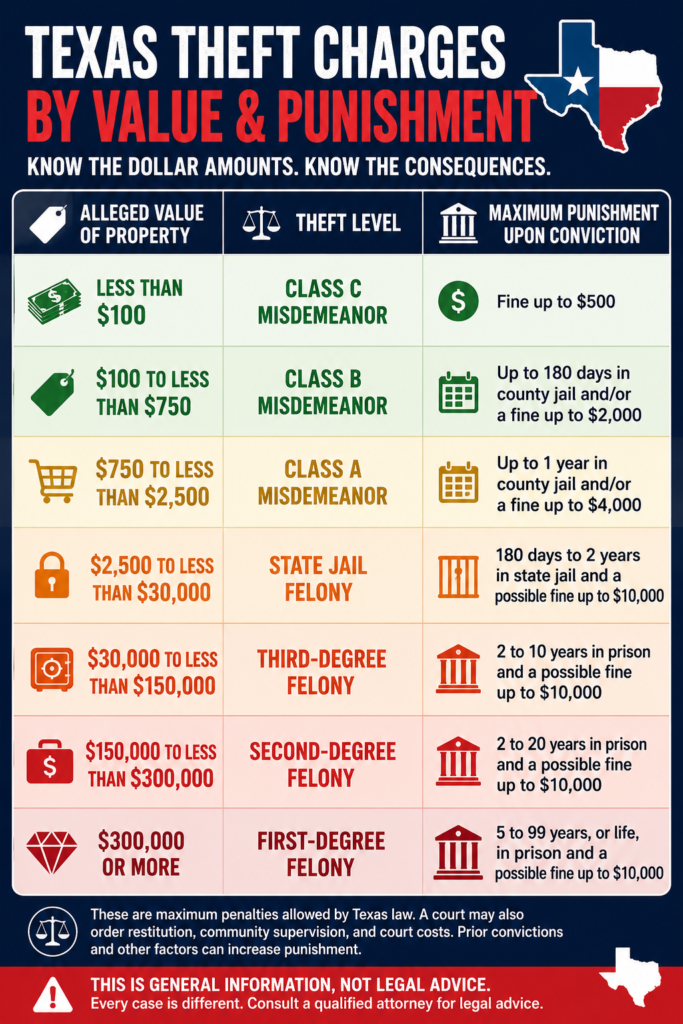
The table below shows the ordinary Texas theft classifications and maximum punishment ranges. These are potential penalties after a conviction, not bond amounts, and they do not mean every person charged will receive the maximum sentence.
| Alleged Value of Property | Theft Level | Maximum Punishment Upon Conviction |
|---|---|---|
| Less than $100 | Class C misdemeanor | Fine up to $500 |
| $100 to less than $750 | Class B misdemeanor | Up to 180 days in county jail and/or a fine up to $2,000 |
| $750 to less than $2,500 | Class A misdemeanor | Up to 1 year in county jail and/or a fine up to $4,000 |
| $2,500 to less than $30,000 | State jail felony | 180 days to 2 years in state jail and a possible fine up to $10,000 |
| $30,000 to less than $150,000 | Third-degree felony | 2 to 10 years in prison and a possible fine up to $10,000 |
| $150,000 to less than $300,000 | Second-degree felony | 2 to 20 years in prison and a possible fine up to $10,000 |
| $300,000 or more | First-degree felony | 5 to 99 years, or life, in prison and a possible fine up to $10,000 |
Texas’s $2,500 felony threshold is state-specific. Other states use different theft-value thresholds, and Texas used lower thresholds in earlier versions of its law. The punishment ranges above come from Texas Penal Code Chapter 12, while the theft classifications are set out in Section 31.03.
A court may also order restitution, community supervision, court costs, or other conditions. Prior convictions and other statutory enhancements can increase the potential punishment in some cases.
Can an Honest Self-Checkout Mistake Be Theft in Texas?
Not automatically. Self-checkout systems ask customers to scan, weigh, bag, and pay for their own purchases, often while managing children, coupons, produce lookups, crowded bags, and scanner errors. A missed item under a purse, at the bottom of a cart, or in a bagging area is not by itself proof that a customer intended to steal.
Some retailers use computer vision and other algorithmic tools to flag possible transaction mismatches. Those systems may identify concrete events, such as an item passing through the bagging area without a matching scan, an item scanned as a different product, or merchandise that appears to bypass the scanner.
The legally important question is still intent. Video may be used to show concrete conduct, such as repeated scan bypasses, barcode switching, concealment, or a person leaving after an alert. But a software-generated suspicion score or a claim that a shopper looked nervous does not, by itself, prove criminal intent.
A customer who realizes an item was missed and offers to pay may have evidence supporting an honest-mistake explanation. Still, a store is not required to end its investigation simply because payment is offered after an employee raises the issue. The surrounding facts, including the video, transaction record, and statements made during the encounter, can matter.
What Can a Store Do If It Suspects Theft?
In Texas, store employees and loss-prevention workers are not police officers. However, Texas law gives a person who reasonably believes someone has stolen or is attempting to steal property a limited privilege to detain that person in a reasonable manner and for a reasonable time to investigate ownership of the property.
This is often called the shopkeeper’s privilege. It may allow a merchant or authorized employee to ask questions, review a receipt or video, recover merchandise, contact police, and preserve evidence. It does not give retail staff unlimited authority to punish someone, use unreasonable force, or pursue a person indefinitely.
A customer does not necessarily have to leave the store before theft can occur. Texas law focuses on unlawful appropriation and intent to deprive the owner. Still, many retailers wait until a person passes the final point of sale before intervening because it can provide clearer evidence of intent and reduce the risk of stopping someone who planned to pay or made an honest mistake.
Retail encounters can escalate quickly, especially in a state where customers and employees may lawfully carry firearms. The shopkeeper’s privilege is limited. It is not a general right to turn a suspected property loss into a dangerous confrontation. Questions about police arrests, vehicle pursuits, or use of force are governed by separate laws and policies.
Can a Store Ban You After a Theft Allegation?
Yes. A private store may generally withdraw permission for someone to enter its property after a suspected theft, even if no theft charge is filed or no conviction results. The store can issue a trespass notice.
If the person later returns after receiving legally sufficient notice, they may face a separate criminal trespass allegation. That later case turns on notice and effective consent, not on whether the original theft accusation was ever proven.
The scope of a retail ban matters. A notice may apply only to one location, or it may expressly cover multiple company-owned locations. It does not automatically apply to every franchise location, unrelated business in the same shopping center, or every store using the same brand name.
Notice can come from the owner or someone with apparent authority to act for the owner. A manager, loss-prevention employee, security officer, or other authorized employee is more likely to create a clear, enforceable record than a cashier acting alone. The key question is whether the person giving the notice had authority, or appeared to have authority, to withdraw permission to remain on the property.
Can Multiple Shoplifting Incidents Be Combined Into One Felony Theft Charge?
Potentially. Texas law allows prosecutors to aggregate the value of two or more theft allegations when they claim the acts were part of one scheme or continuing course of conduct. The combined value can then be measured against the ordinary theft-value ladder.
For example, several alleged $200 shoplifting incidents may be treated differently if prosecutors can prove they were part of a continuing scheme and the combined value reaches $2,500. At that point, the State may seek a state jail felony rather than treating each allegation as a separate misdemeanor.
A retailer’s internal record of repeated losses is not enough by itself. The State must still prove the alleged incidents, the person’s identity, the value of the property, and the required connection between the events.
Could Organized Retail Theft Be Charged Instead of Ordinary Theft?
In some situations, prosecutors may file Organized Retail Theft charges instead of, or in addition to, an ordinary theft allegation. Unlike a typical shoplifting case involving a single incident, Organized Retail Theft generally involves allegations that multiple people acted together to steal from a merchant, that someone repeatedly stole from a retailer within a 180-day period, knowingly benefited from organized retail theft committed by others, or worked with others to overwhelm a store’s security or law enforcement response during the theft.
These investigations often involve more than a store surveillance video. Prosecutors may rely on cellphone records, license plate reader data, financial records, online marketplace listings, search warrants, witness testimony, and evidence that merchandise was transported or resold after it was stolen. The State must still prove every element of the offense beyond a reasonable doubt, including the defendant’s alleged role in the activity. Simply being present with another person or purchasing merchandise without knowing it was stolen does not automatically establish Organized Retail Theft. The specific facts and evidence determine whether the offense can be proven.
When Value Is Not the Whole Story
Some theft allegations can be elevated because of facts other than the dollar value. Examples can include prior theft convictions, theft of a firearm, property taken directly from another person’s body or immediate possession, and certain specialized property categories. For example, taking a wallet from someone’s pocket or a phone from their hand may be treated more seriously than taking the same item from an unattended table.
Texas law also addresses theft involving items such as certain metals, livestock, catalytic converters, controlled substances from specified locations, and other specially protected property. The exact charge depends on the statute and facts.
Intellectual-property allegations are also different from ordinary shoplifting. Taking confidential business information, trade secrets, computer data, or proprietary source code may be charged under separate Texas or federal laws. Those cases may involve questions about access, confidentiality, business value, and computer use rather than the retail value of a physical item.
Theft Allegations Involving Elderly Victims
Some theft cases involve allegations that the victim was an elderly individual or another vulnerable adult. These cases frequently arise from accusations involving caregivers, family members, powers of attorney, joint bank accounts, financial exploitation, or other relationships involving trust. Although the value of the property remains important, prosecutors may pursue enhanced penalties or additional criminal offenses depending on the facts and the applicable statute.
A conviction involving an elderly victim may carry significantly more severe consequences than an ordinary theft allegation. Depending on the circumstances, a misdemeanor theft charge may be enhanced to a felony, and an existing felony theft charge may be elevated to the next higher degree of felony. Those enhancements can substantially increase the potential prison sentence and other penalties a defendant faces if convicted.
When Is an Unpaid Debt or Promissory Note Theft?
Usually, an unpaid debt is a civil dispute, not criminal theft.
If someone signs a promissory note, borrows money intending to repay it, and later fails to pay because of financial hardship or a broken promise, that does not automatically prove theft. The key issue is intent when the money or property changed hands.
The analysis may change when there is evidence that the person used deception from the beginning. Examples might include using a false identity, offering forged collateral, fabricating a business purpose, or following a pattern of obtaining money through knowingly false representations. Those facts may support an allegation of theft by deception or fraud rather than a simple breach of contract.
What Does “Wage Theft” Mean in a Theft Case?
The phrase “wage theft” is commonly used when an employer fails to pay wages, overtime, or tips. Those disputes usually involve employment-law remedies, wage claims, or civil litigation rather than an ordinary Texas theft prosecution.
Employers sometimes use similar language when accusing workers of falsely claiming pay. This is more often called time theft or payroll fraud. Knowingly falsifying time records, having someone else clock in, or intentionally submitting hours not worked can lead to discipline, repayment demands, or potentially criminal allegations depending on the evidence.
Could you already have a warrant for your arrest? Check now!

Theft Charges Involving Minors or Adults Who Use Children
A young child who innocuously takes a valuable item often becomes a private disciplinary matter before it becomes a criminal case. Age matters significantly in Texas juvenile law, and a small child is not treated like an adult defendant.
An adult who directs a child to steal does not avoid responsibility because the child physically carries the item. Texas law can hold an adult responsible when evidence shows the adult intentionally caused, encouraged, directed, or used a child to commit theft. Video footage, witness statements, text messages, or repeated conduct may become important evidence in those cases.
How Is the Value of Property Determined?
Value is not always the original retail price. Depending on the property and circumstances, the State may rely on fair market value, replacement cost, receipts, inventory records, ownership records, expert testimony, or other evidence.
A value dispute can be especially important near the $2,500 threshold. The difference between a claimed value of $2,400 and $2,600 can change an allegation from a Class A misdemeanor to a state jail felony.
A theft conviction can also create consequences beyond confinement and fines. It may affect employment, professional licensing, housing, education, immigration status, and future opportunities. A felony conviction can also affect firearm rights and other civil rights.
What Happens After a Theft Accusation?
A theft allegation may begin with a store investigation, police report, citation, or arrest. In retail cases, the store may provide video, transaction records, witness statements, recovered merchandise, and internal loss-prevention documentation to law enforcement.
Police may investigate and prosecutors decide whether to file charges. If an arrest occurs, the person may be booked, taken before a magistrate, and have bail set. The case may later be dismissed, reduced, resolved through an agreement, or proceed to trial.
Anyone accused of theft should avoid discussing the facts over recorded jail calls or casual messages. Statements made to store staff, police, friends, family members, or on social media can later become evidence.
Possible Defenses to a Texas Theft Charge
A theft defense depends on the facts, but common issues include lack of intent, an honest self-checkout mistake, scanner error, permission or a reasonable belief of permission, a dispute over ownership, incorrect value, misidentification, or weak video evidence.
In alleged aggregate-theft cases, the defense may challenge whether separate incidents involved the same person, whether the State can prove each event, and whether the events were truly part of one continuing scheme.
In debt and workplace cases, the defense may focus on whether the dispute is civil, contractual, or based on an employer’s dissatisfaction rather than criminal intent.
The Dollar Amount Matters, but Intent and Circumstances Matter Too
In Texas, $2,500 is generally the line between misdemeanor and felony theft, but the dollar amount is only one part of the analysis. The State must still prove unlawful appropriation, lack of effective consent, and intent to deprive the owner of property.
Whether the allegation involves a self-checkout mistake, repeated shoplifting accusations, a debt dispute, a workplace claim, or a retail detention, the facts can matter as much as the value. A Texas criminal defense attorney can evaluate the charge, preserve evidence, challenge weak assumptions, and help someone understand the potential consequences and available options.
Frequently Asked Questions
What amount of theft is a felony in Texas?
Is theft under $2,500 a misdemeanor in Texas?
Can a self-checkout mistake lead to a theft charge in Texas?
Can a store detain you for suspected shoplifting in Texas?
Do you have to leave the store before shoplifting is considered theft?
Can a store ban you after a theft allegation in Texas?
Do you have to show your receipt before leaving a store in Texas?
Can multiple shoplifting incidents be combined into one felony charge?
Is failing to repay a loan or promissory note theft in Texas?
What are the penalties for theft in Texas?
This article provides general information and is not legal advice. Every case depends on its particular facts, charges, criminal history, court orders, and applicable law.