Legally reviewed by Chris Jeansonne, Criminal Defense Attorney, Dunham & Jones, Attorneys at Law, P.C. · Last reviewed: August 31, 2026
Criminal trespass in Texas can involve much more than sneaking onto private property. A person may face a criminal trespass charge after refusing to leave a store, returning to a business after receiving a trespass warning, entering fenced property, going somewhere they have previously been told not to enter, or remaining on property after permission to be there has been withdrawn.
Under Texas Penal Code Section 30.05, a person commits criminal trespass if the person enters or remains on or in another person’s property without effective consent and had notice that entry was forbidden or received notice to leave but failed to do so.
This means criminal trespass cases often turn on more than who owns the property. Notice, consent, authority, the scope of a warning, and a person’s legal right to possess or occupy the property can all matter.
What Counts as Notice of Criminal Trespass in Texas?
Texas recognizes several ways a person can receive notice that entry is forbidden.
Notice can include:
- Oral or written communication from the owner or someone with apparent authority to act for the owner
- Fencing or another enclosure obviously designed to exclude intruders or contain livestock
- Signs reasonably likely to come to an intruder’s attention indicating that entry is forbidden
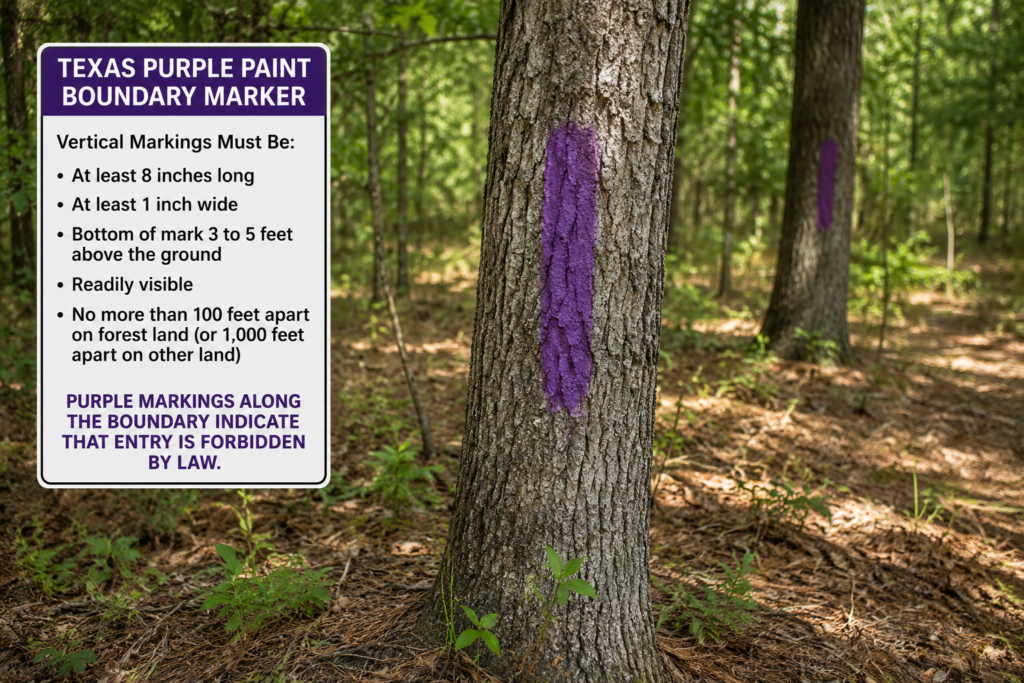
- Qualifying purple paint markings
- The visible presence of certain cultivated crops
A person can also initially enter property legally and later lose permission to remain. For example, a customer who enters a store during normal business hours may be told to leave by an authorized manager. Refusing to leave can potentially result in criminal trespass.
Texas Penal Code Section 30.05 also specifically defines “entry” as intrusion of the entire body.
Does a No Trespassing Sign Have to Be Official in Texas?
Texas does not require a special government-issued sign for ordinary criminal trespass notice under Section 30.05.
A professionally manufactured sign, a sign purchased online, or even a homemade sign may potentially provide notice if it is reasonably likely to come to an intruder’s attention and clearly indicates that entry is forbidden.
Texas also recognizes qualifying fencing as notice. A property owner therefore does not necessarily need both a fence and a No Trespassing sign.
Purple paint has more specific requirements. To qualify as statutory notice, the vertical purple markings must be at least eight inches long and one inch wide, with the bottom of the mark between three and five feet above the ground. The markings must be readily visible and spaced no more than 100 feet apart on forest land or 1,000 feet apart on other land.
Separate Texas laws impose specific requirements for certain firearm-related signs, so those signs should not be confused with ordinary No Trespassing signage.
Who Can Issue a Trespass Warning in Texas?
The property owner is not necessarily the only person who can tell someone to leave.
Texas law recognizes oral or written notice from an owner or someone with apparent authority to act for the owner. Depending on the circumstances, this might include a store manager, property manager, security representative, or another authorized person.
Authority can become especially important when the scope of a warning is disputed. An employee angrily saying, “You’re banned from every store in America,” may present a different issue from a formal corporate trespass notice issued through authorized management or loss prevention.
Can a Store Ban Someone Accused of Shoplifting?
Yes.
A private retailer generally does not have to obtain a shoplifting conviction before withdrawing permission for someone to enter its property.
A store may issue a trespass warning after suspected shoplifting even if the person is never arrested or charged, or if the theft case is later dismissed or results in an acquittal.
The two issues are legally distinct. A theft prosecution concerns whether the State can prove theft. A subsequent criminal trespass case may concern whether the person entered or remained on property after receiving notice that they were no longer permitted there.
Dismissal of the original shoplifting allegation therefore does not automatically cancel the store’s trespass warning.
Can Walmart or Another Chain Ban Someone From Multiple Stores?
Potentially. A large retailer’s trespass warning may cover more than the individual location where the original incident occurred.
A retail ban may apply to one address, multiple locations, affiliated businesses, or potentially a broader group of company properties depending on what the person was told and the authority of the person issuing the warning.
A company may also communicate that someone is prohibited from its properties in other states. However, whether entering a property in another state constitutes criminal trespass is governed by that state’s law.
Anyone receiving a retail trespass warning should determine exactly which properties it covers rather than assuming it applies only to one store or automatically applies nationwide.
Can a Trespass Warning Be Appealed or Rescinded?
Texas Penal Code Section 30.05 does not create one statewide appeal or rescission process for ordinary private-property trespass warnings.
A person who wants a private business to remove a warning can contact someone with appropriate authority and request that permission to enter be restored. Making that request in writing and obtaining written confirmation of any rescission can help prevent future disputes.
Do not assume that a casual invitation from an employee overrides a management or corporate-level ban. Likewise, asking for reconsideration does not itself restore permission to enter.
Texas cases have involved defendants who argued that earlier trespass warnings had been withdrawn or superseded by later permission. Whether consent was actually restored can become an important factual question.
Government agencies, universities, and other public institutions may have their own formal appeal procedures and deadlines.
Can You Be Trespassed From Public or Government Property?
Yes, although government property can raise additional legal and constitutional questions.
Government ownership does not create an unlimited right to access every location. A courthouse may restrict access to judges’ chambers, a public library may restrict staff-only areas, and a public park may have lawful operating hours.
However, excluding someone from government property used for speech, protest, public meetings, or other protected activity can raise constitutional issues that generally are not present when a private homeowner tells someone to leave.
The location, reason for exclusion, applicable rules, and nature of the property can all matter.
Can a Business Trespass Someone for a Discriminatory Reason?
Private property rights remain subject to applicable civil rights laws.
Federal law prohibits certain covered places of public accommodation from discriminating based on race, color, religion, or national origin. Other federal, state, or local protections may apply depending on the business, location, and circumstances.
Whether a business unlawfully discriminated against someone and whether that person subsequently committed criminal trespass can be separate legal questions.
A person who believes an exclusion is unlawful should generally challenge it through the appropriate legal or administrative process rather than simply returning to the property and risking a criminal charge.
Criminal Trespass, Tenants and Squatters
Property ownership does not always determine who has the present legal right to occupy a residence.
A landlord generally cannot avoid applicable Texas eviction procedures simply by declaring a lawful tenant a trespasser. Texas Property Code Chapter 24 governs forcible entry and detainer proceedings and establishes procedures for recovering possession from tenants and certain other occupants.
Texas substantially revised its eviction procedures effective January 1, 2026, including procedures affecting people who are not entitled to enter, occupy, or remain in possession of property.
The word “squatter” can also hide important legal distinctions. A stranger who breaks into a vacant building may present a very different situation from a tenant whose lease has expired, an adult child who has been living in a parent’s home, an ex-partner who established residence there, someone who originally had permission to move in, or a tenant at will or by sufferance.
Whether someone can be treated as a criminal trespasser or must instead be removed through an eviction proceeding can depend on how that person obtained possession and whether the person has or previously had a lawful right to occupy the property.
Is Criminal Trespass the Same as a Protective Order?
No.
A trespass warning concerns permission to enter or remain on property. A protective order is a court order that can impose broader restrictions on a person’s conduct, contact, or proximity to specified people and locations.
A person could therefore violate a protective order without physically entering another person’s property. Likewise, a property owner generally does not need a protective order simply to communicate that someone is no longer permitted on private property.
Can a Homeowner Post a “Trespassers Will Be Shot” Sign?
A threatening sign does not expand a property owner’s legal authority to use force.
Texas Penal Code Sections 9.41 and 9.42 address circumstances in which force or deadly force may be justified to protect property. Deadly force requires substantially more than the mere existence of a trespass.
A homeowner cannot create a legal right to shoot ordinary trespassers simply by posting a sign threatening to do so.
Charged with criminal trespass in Texas? Call Dunham & Jones 24/7 at 800-499-8455 for a free consultation.
What Are the Penalties for Criminal Trespass in Texas?
Criminal trespass is generally a Class B misdemeanor, punishable by up to 180 days in jail, a fine of up to $2,000, or both.
Certain circumstances can change the classification.
Criminal trespass may be a Class C misdemeanor when committed on agricultural land within 100 feet of the property’s boundary or on residential land within 100 feet of a protected freshwater area, unless another statutory enhancement applies.
Criminal trespass can become a Class A misdemeanor in circumstances specified by Section 30.05, including certain offenses involving a habitation or shelter center, a Superfund site, certain critical infrastructure facilities, specified institutions of higher education or residential treatment centers, or when the person carries a deadly weapon during the offense.
In a narrower circumstance, criminal trespass can be a third-degree felony if the State proves the person committed the trespass in the course of committing certain smuggling-of-persons conduct under Texas Penal Code Section 20.05(a)(2).
Because classification depends heavily on the property and circumstances, anyone charged with criminal trespass should determine exactly which provision prosecutors allege applies and contact a criminal attorney.
Criminal Trespass vs. Civil Trespass in Texas
Criminal trespass and civil trespass are separate legal concepts.
Criminal trespass under Texas Penal Code Section 30.05 is prosecuted by the State and requires proof of the elements of the criminal offense.
Civil trespass can instead involve a property owner’s claim arising from an unauthorized physical entry onto property and may result in civil remedies. A property dispute that may support a civil claim does not automatically establish that someone committed criminal trespass.
Criminal Trespass vs. Burglary in Texas
Criminal trespass does not require an intent to steal.
Burglary under Texas Penal Code Section 30.02 involves additional statutory elements concerning unlawful entry and the commission or intended commission of specified offenses.
Texas also defines “entry” differently for these offenses. For criminal trespass, Section 30.05 defines entry as intrusion of the entire body. For burglary, entry can include intrusion of any part of the body or any physical object connected with the body.
Someone can therefore potentially commit criminal trespass without intending to steal or commit another crime on the property.
Common Defenses to Criminal Trespass Charges
The specific facts surrounding the property, notice, consent, and alleged entry can be critical. Potential issues in a Texas criminal trespass case include whether:
- The defendant actually received legally sufficient notice
- The person issuing the warning had apparent authority
- The defendant had effective consent to enter or remain
- Consent was subsequently restored
- The warning actually covered the property entered
- Signs, fencing, or other purported notice satisfied Texas law
- The defendant had a legal or possessory right to occupy the property
- The State can prove every required element beyond a reasonable doubt
Frequently Asked Questions About Criminal Trespass in Texas
Frequently asked questions about criminal trespass in Texas.
Can I be arrested for trespassing if there is no sign?
Is a fence enough to establish notice?
What if I leave immediately when a store tells me to leave?
Can a store trespass me without proving I shoplifted?
Does dismissal of a shoplifting charge cancel a store ban?
How long does a trespass warning last in Texas?
How do I appeal a trespass warning?
Can one Walmart ban me from every Walmart?
Can my landlord simply have me arrested for trespassing?
What should I do if I am charged with criminal trespass in Texas?
This article provides general information and is not legal advice. Every case depends on its particular facts, charges, criminal history, court orders, and applicable law.